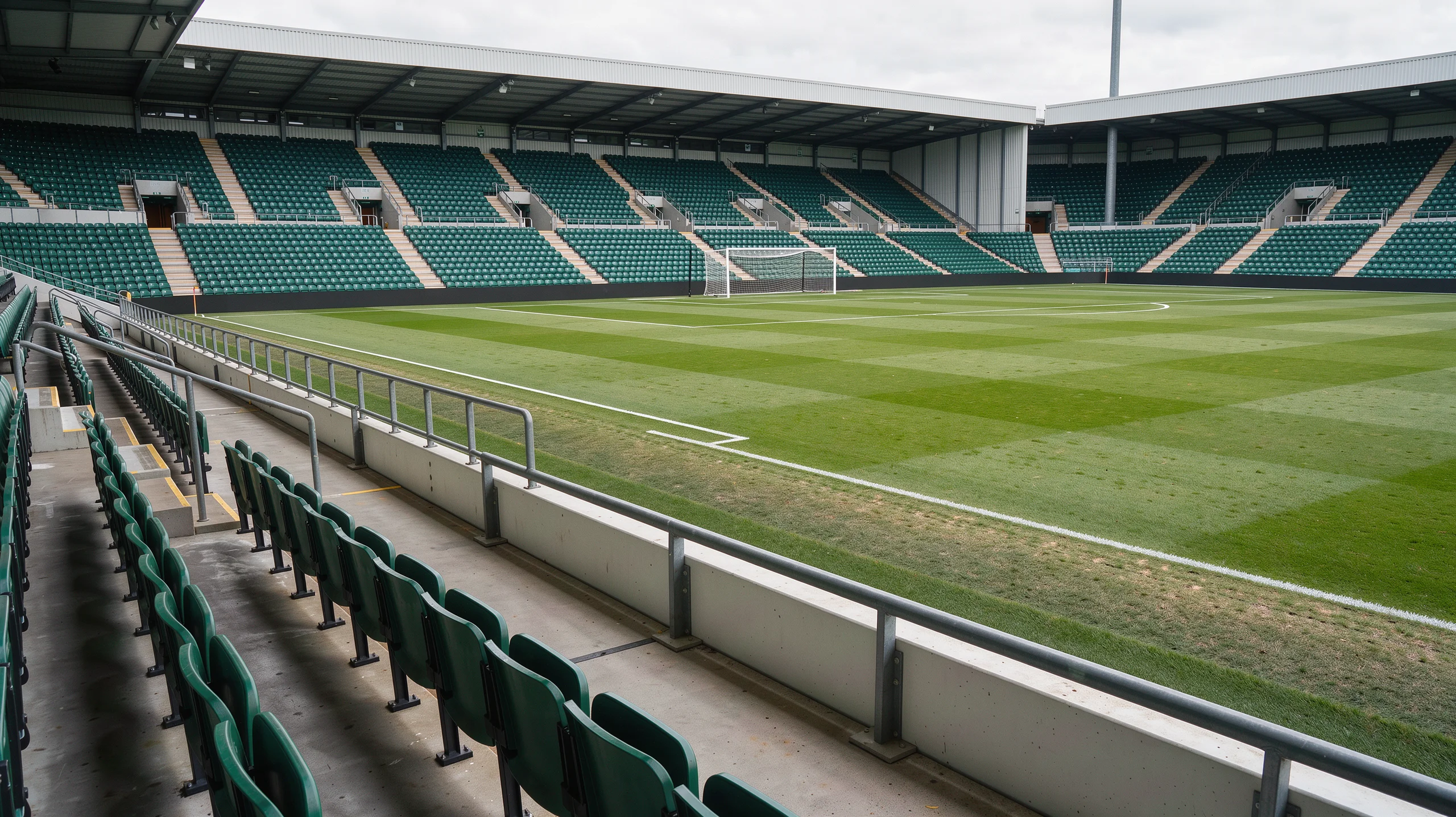
 This page shows where the numbers on the data pages come from and how I work them out, so that you can trust them or know their limits. The empty pitch in the picture stands for the game behind the numbers. I am responsible for data and method.
Next come the data source, fixture difficulty and possible final position, then level on points, the Table Predictor and the limits.
At a glance
- All fixtures and results come from Sportmonks, and the table and the difficulty are my own calculation.
- Each match is rated on how many points per game the opponent earns at its venue, then smoothed and averaged over the run-in.
- You also find rules for teams level on points and what the Table Predictor does not do.
Where the data comes from
Fixtures, kick-off times, results and TV channels come from the data provider Sportmonks, and so do postponements, points adjustments and the zone of each table position. The TV channels are those for the United Kingdom. Everything else, from the table to the difficulty, I work out myself.
- Opponent position: the opponent's current place in my own table.
- Form: the opponent's results in its latest matches, five at most.
- Difficulty: a value from 1 to 10 for each match and for the whole run-in.
- Direct duels: the opponent's distance in points, shown when it is 3 points or fewer.
- Maximum points: current points plus 3 for every remaining match.
The head of a league or club page names the matchday it stands after and the date of its last update. I would check that line first, because the position is only as current as that date. Where a match has no TV channel yet, the page says so.
How fixture difficulty is calculated
A run-in is harder when the opponents score more points at the venue of the match, so the number looks at opponent and venue together. The starting point is the opponent's points per game there. I find it most useful for comparing two clubs' run-ins.
| Starting point | Points per game of the opponent |
|---|---|
| Venue | Opponent's away average for a home match, its home average for an away match |
| Smoothing | Three imagined games at the league average of that venue |
| Averaging | Mean over all remaining opponents, taken before rounding |
| Scale | 1 (easy) to 10 (hard) |
The number compares run-ins and says nothing about a club's form or the result of a single match, and it is no prediction. I smooth each value with three imagined games at the league average, so that a few matches do not carry too much weight.
The possible final position
Yes, you can rely on the possible final position because it is a safe limit on points alone. Whatever happens in the remaining matches, the club cannot finish above or below the range shown. A dash only means that my simple check cannot set a limit yet.
The limit is not a boundary a club can reach exactly. My check counts points only, so goal difference and head-to-head do not enter. The range shown can therefore be wider than the one that is exactly possible.
Phrases such as mathematically safe or mathematically relegated mean that no possible course of the remaining matches can change the outcome. Where my limit does not say that yet, I prefer a dash to a wrong promise.
Teams level on points
When points are equal, the table follows fixed rules. Below I set out the rulebooks of the Premier League and the DFL and, apart from them, my own handling where the pages have to decide for themselves.
Premier League rules
Between clubs level on points, the Premier League follows its Handbook 2026/27, rules C.4 to C.7 and C.17. During the season, goal difference and goals scored decide, and clubs still level share the place.
- Goal difference (rule C.5)
- Goals scored (rule C.6)
- Points from the matches between the tied clubs (rule C.17.1)
- Away goals in those matches (rule C.17.2)
- A deciding match on neutral ground (rule C.17.3)
Criteria 3 to 5 only count at the end of the season, when the title, relegation or a place in another competition depends on them. Until then, clubs level on goal difference and goals scored share a place, and the data pages show them with the same number.
I use criteria 3 and 4 only once every match of the league has a result, real or predicted, and only for a group that includes first place or straddles a zone boundary. Criterion 5, the deciding match, is not calculated.
DFL rules for the Bundesliga
As of 13 November 2026, the DFL Rules of Play set the order for the Bundesliga. If not all matches between the clubs concerned have been played, only the first two criteria apply, and clubs still level share the place.
- Goal difference
- Goals scored
- Aggregate result of both legs in the head-to-head
- Away goals scored in the head-to-head
- All away goals scored
- A deciding match on neutral ground
Unlike the Premier League, the DFL puts head-to-head and all away goals into its regular order. On the Bundesliga tables, criteria 3 to 5 count only once the matches between the tied clubs all have a result, real or predicted, and a deciding match is not calculated.
How I handle open cases
In the Bundesliga, the head-to-head counts only once every match between the tied clubs has a result. Until then, DFL rules stop after goal difference and goals scored and clubs level share the place, as Premier League rule C.7 does. Counting predicted scores as results is my own handling.
With more than two clubs level, I build one small table from their matches against each other, and that is my interpretation. To me, one table for the whole group is easier to check by hand than a chain of special cases.
Points deductions
Points deductions count in the table. The adjustment comes from Sportmonks, and I add it to the points before sorting, so it changes zones, gaps and maximum points as well as the possible final position, but not the difficulty.
A deduction is marked with an asterisk on the points in the table, the overview and the Table Predictor, with a note under the table that the adjustment is included. The matrix and the list of remaining matches show the corrected points without the asterisk.
What the Table Predictor does and does not do
The scores you enter in the Table Predictor are added to the table, and the position they produce appears in brackets next to each club. Played matches keep their real score.
- Games without a score: they do not count in the table yet.
- Prediction: there is none, with no forecast, no simulation and no suggestions.
- Championship play-offs: the play-off matches themselves are not part of the calculation.
- Bundesliga relegation: the relegation matches are left out as well.
- Deciding match: one after a complete tie is not calculated.
What you see is an interim table once you have entered scores for some, but not all, of the remaining matches, and an interim table is not a final one. In my view, the predictor is good for playing through your own scenarios, and not for reading what will happen.
Limits of the numbers
The European zones on the data pages follow table position only, and the winners of the FA Cup, the League Cup or the DFB-Pokal do not enter my calculation. A zone therefore marks a position and not a guaranteed European place.
If my own points differ from the Sportmonks table, the pages say so. The overview then names no possible final positions, and the Table Predictor warns that its table may differ from the official standings.
Data and method of these pages are my responsibility, and on the About page you can read who I am. In my verdict, the numbers are good for comparing, not for forecasting.
Frequently asked questions
These short answers cover data source, difficulty and Table Predictor, and each points to the section with the full explanation.
Where do the fixtures and results come from?
Fixtures and results are supplied by Sportmonks, and so are the TV channels. What I take over and what I calculate on top is listed in the section “Where the data comes from”.
Why does a page show different points from another table?
My own points can differ from the Sportmonks table, and the pages say so openly. You can read how in the section “Limits of the numbers”.
Is the possible final position a prediction?
No. The possible final position is not a prediction but marks safe limits, and a club does not have to reach either edge. You find the details in the section “The possible final position”.
What happens when the head-to-head record is incomplete?
In the Bundesliga, the DFL rules skip the head-to-head and let clubs level share the place until every match between them has a result. I choose to count predicted scores as results here. The section “How I handle open cases” explains it.
Does the Table Predictor count games I do not tip?
No. A match without a score from you does not count. The Table Predictor adds only the scores you enter to the table. You can read what it leaves out in the section “What the Table Predictor does and does not do”.